


With more people working hybrid, from home, or hot-desking, businesses need to use their office space in smarter ways. Why? To boost work efficiency and reduce attrition for their employees.
Over the past few years, working habits have transformed. 28% of UK working adults hybrid worked between January and March 2025.
In the modern world of work, businesses have more options than ever. The upgrades available range from digital door locks to smart presentation systems. Using the latest smart office technology we can create a more easy and streamlined work environment where employees can flourish through teamwork.
This blog will explore six must-have smart office technologies you can install to upgrade your approach to work from top to bottom.
What Is a Smart Office?
A smart office is a workspace that uses high tech solutions to boost workflow, worker wellbeing and team effort. Smart office tech can be used to make working in concert seamless, both with others in the office, and those who work from home.
What Is Smart Office Technology?
Smart office technologies offer a number of ways in which we can work together more effectively. We once thought that email was the solve-all solution for group effort in the workplace. However, advancements such as instant messaging, sharing files via the cloud, and video calls have completely changed our working lives.
Smart Conferencing
Meetings and conferences are mainstays in the business landscape, but the pandemic and the cost of living crisis have transformed our communication habits. In-person meetings are no longer as vital as they were a decade ago.
On top of that, there are no signs of hybrid working going away any time soon. That makes it crucial for offices to have a conferencing system for meetings involving those working from home.
With an expertly installed system you can host meetings between employees in the office and those working remote. You can even capture and record meetings for those who are not able to attend. This offers a simple way to make sure teams stay in the loop.
The impact of this change in work habits has touched all industries. Our engineers have even installed a Logitech Meetup Smart Conferencing system in St Paul’s Cathedral!
Modern tech allows a range of versatile setups to suit any office or boardroom. For example, smaller offices can have a huddle video meeting room for just a few workers and one screen. This can be scaled up for wider spaces too, with extra screens to make sure that everyone is seen and heard, even in the largest meetings.
An expert installer such as Chris Lewis can craft you a bespoke video conference room or lecture theatre to fit your exact needs, making sure all audio-visual devices are fully optimised. Or we can upgrade or retro-fit your current setup to bring your conferencing up to date.
Smart Presenting
Smart office technology can do more than improve your video conferencing facilities, though. It can also change the way you and your colleagues present in meetings.
Smart presentation systems improve team working and give workers better tools to visualise ideas or share screens with colleagues, clients and partners.
These systems also let users present wirelessly with handheld devices such as phones, laptops or tablets. This removes the need for excessive wiring and lets employees work smoothly without distraction.
You can even go one step further to improve group working by integrating smart whiteboards into your office setup. Unlike other smart products, smart whiteboards don’t require complex technical knowledge. Using either a pen or a fingertip to control, they employ the same touchscreen tech most of us already know well.
The newest smart whiteboards can even display 4K images and video, and many have light sensors that smartly adjust their brightness based on ambient light levels.
Smart Office Control
There is more to a smart workspace than the technology you interact with on a day to day basis, though. In fact, there are a variety of smart integration options.
By using the latest smart office technology solutions you can build a work environment to improve comfort and efficiency in your workforce.
Some examples include:
Smart Energy Solutions
Modern energy solutions increase efficiency, reducing the carbon footprint of your office. With an advanced climate control system, businesses can regulate office temperature based on usage patterns, company calendars and weather forecasts. This means both lower energy costs and better employee work rate at the same time.
Smart Lighting
Similarly, smart lighting can use sensors to turn on when someone enters a room and off once the last person has left. According to Gartner, this could reduce energy costs by up to 90%.
Daylight sensors can dim your lights to match your required lux level. Colour changing lights can change the colour tone of your lighting depending on the time of day and the amount of daylight. For example, during the day you want more white light but as the sun sets you may want lights to be a more yellow colour.
When paired with automated blinds the two can work in concert to boost the levels of natural light in the building. These Internet of Things (IoT) technologies are perfect for making your office more energy-efficient, lowering costs and reducing your carbon footprint.
Smart Access Control
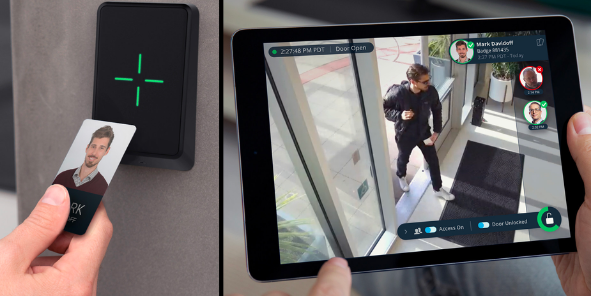
Smart access control can make office management more efficient and boost work rate at the same time. With a cloud system, HR and Security teams get a more accessible way to review security for their building, so they can monitor occupancy better.
Many modern access control systems use your smartphone as a security credential to get into your office, rather than fobs or cards. This is great for both reducing costs issuing key fobs and cards, as well as making life easier for users with a greater tendency to misplace their key cards. Besides being less likely to be misplaced, it is far harder to clone access credentials held on a phone. Plus, phone credentials have their own built-in two-factor authentication, as the phone needs to be unlocked with a code, pattern or facial recognition scan.
With biometric credentials like face or retina scanning for access control, cloning and theft becomes near-impossible.
Access control systems can also be integrated with a visitor management and desk/room booking system to grant access to visitors and allows them into meeting rooms when required.
Smart Security
Smart security can benefit an office in a number of ways, from remote monitoring of your systems to accurate people management.
By installing a smart alarm, you remove the worry that the last employee to leave the building correctly set the alarm for the night. You can arm and disarm the intruder alarm remotely, from any location, at any time. All that you need is a network connection and a handheld device such as a mobile phone or tablet to use the management system.
When you integrate access control with CCTV you can visually verify people who want to come into the office or specific rooms in it, then grant or deny access. Security cameras can also show you a history of access events throughout the building.
The ability to monitor security systems remotely removes the need for on site security staff to occupy the building outside of working hours. This eliminates the expense of hiring this out of hours staff.
Environmental Sensors
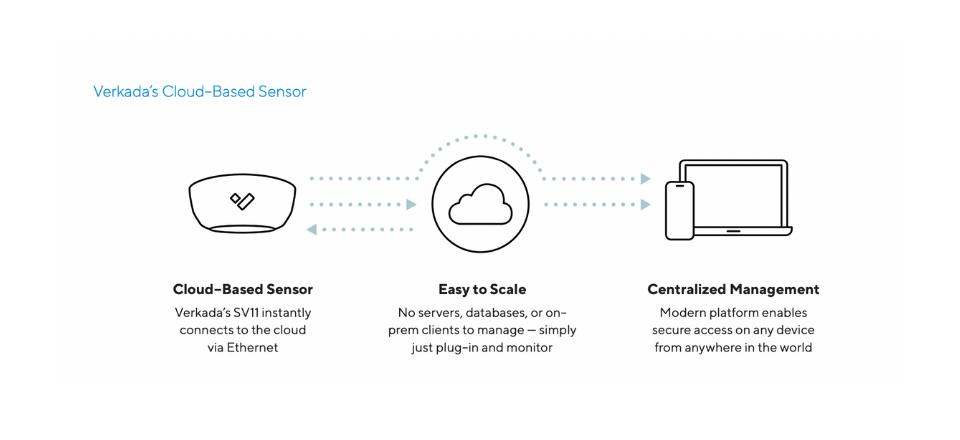
Environmental sensors such as Verkada’s cloud SV11 are smart all-in-one-units which can track air quality changes in a space. They can scan a range of elements including Carbon Monoxide, Humidity, Temperature, Particulates and Ground-Level Ozone, to name a few. This is a handy tool to use in workspaces such as server rooms and production floors, where health and safety risks can be invisible.
Large commercial sites can present a number of risks, including volatile organic compounds from cleaning sprays. Being able to check the levels of these VOCs is helpful, as the use of these solutions in offices has grown hugely due to the pandemic.
The ability to see information about air quality can help companies protect the health and safety of their staff. Keeping a healthy work space in these areas will reduce illness and absence in the office, boosting the output of the business. Beyond being an ethical thing to do, this lowers the chances the business would be liable or subject to an insurance claim in the event of an outbreak (or chemical spill in more industrial workplaces).
Sound Masking Technology
Sound masking is still quite a new office innovation in 2026. It’s designed to boost focus in the workspace by damping noise levels. It works much like white noise does, creating ambient noise precisely engineered to the pitch of human speech – making background chatter harder to hear and so, less of a distraction.
That’s not to say it adds a distracting “fan-like” sound to the room. Unlike white noise, sound masking is designed to be easy on, or even pleasant to, the human ear. When installed properly, it should just blend into the background “hum” of the workplace – without static, distortion or buzz.
It won’t make working together any more difficult either. While designed to limit the noise of chat, sound masking doesn’t stop close conversation from being heard. It all depends on the distance. If a person next to you speaks, you will still hear them clearly.
Final Thoughts
Whether you want to install a brand-new smart office technology or upgrade your existing ones, you can design the ideal workspace for both you and your workforce. As well as develop an environment that satisfies on both a professional and personal level.
Smart office systems can improve all aspects of a working environment. Everything from well-being and hot-desking to productivity and health & safety. For instance, you can link smart security systems to the building’s fire detection system so it will call the emergency services as soon as an alarm is triggered.
Although smart tech integration may sound like a costly expense; it doesn’t have to be. A cost-effective strategy used by businesses across the globe is leasing smart tech for your business. Through leasing, you’ll get cutting-edge technology at an affordable price, giving you the tools to keep on top of new smart office trends.
Finally, in order to reap the full benefits that smart office technology has to offer, you need to employ an expert who can design and install a bespoke smart office system tailored to your business needs.
At the Chris Lewis Group, we are leaders in smart technology solutions, with over 15 years of experience in this relatively new industry. Whether you all you need is a smart conferencing system, or have an interest in all types of smart office solutions, we are on hand to design and create your plans, as well as support you afterwards.
